The performance, reliability, and maintenance cost of a rotary screw air compressor are heavily influenced by its oil. Both the condition of the oil while in service and the specific type of oil or base stocks used are critical to compressor operation and longevity. Compressor Original Equipment Manufacturers (OEMs) and oil suppliers offer a variety of oil base stocks and formulations for compressor users to choose from. However, all too often, users are not consulted, and new compressors are supplied with the OEM’s standard “factory fill” without considering the compressor’s unique operating conditions or environment. Factors such as the compressor’s location, ambient temperatures, humidity levels, air quality, load profile, duty cycle, and maintenance practices all affect the oil’s performance and service life.
So, how do you determine which type of oil is best for your compressor? The answer lies in understanding the various functions that rotary screw compressor oils must perform and having a basic knowledge of the different oil base stocks commonly used. These oils have inherent performance properties, strengths, and weaknesses that can directly impact compressor performance.
Oil Functions in Rotary Screw Air Compressors
Unlike typical lubricants used in most rotating equipment, oil-injected rotary screw air compressors require specialized fluids (lubricants and coolants) that perform a wide range of vital functions. Because of the rotary screw’s unique “forced-contamination” design, compressor fluids must withstand constant exposure to contaminants while maintaining performance and protection. These fluids operate in an aggressive, chemically reactive, and contaminant-rich environment. The main functions that all rotary screw air compressor oils must perform include:
- Lubrication: The primary function of compressor oil is to lubricate the compressor’s bearings, gears, and seals to minimize friction and wear. All commonly used compressor oil base stocks offer sufficient lubricity, film strength, and shear stability, allowing them to perform well as lubricants—provided they are properly monitored with routine oil analysis, and contaminants are kept under control.
- Cooling: Roughly two-thirds of a rotary screw air compressor’s horsepower is converted into heat within the air-end. Compressor oils must serve as heat transfer fluids to absorb this heat and efficiently reject it through the cooler. The oil’s thermal conductivity, viscosity, viscosity index (VI), and varnish or sludge-forming tendencies are critical properties that must be considered for optimal cooling. Oil formulations that do not perform well in these areas can lead to elevated operating temperatures, accelerate oil degradation, and reduce both the oil’s and the compressor’s life.
- Sealing: Compressor oils also help improve compressor efficiency and reduce energy consumption by providing an airtight seal between the air-end rotors and stator, minimizing internal “blow-by.” Oil viscosity and viscosity index (VI) are key properties affecting the oil’s sealing ability, friction, drag, and parasitic losses. Oils that tend to form varnish or become contaminated are prone to increased viscosity, which can negatively impact sealing, cooling, and compressor efficiency
- Cleaning and Protection: Air compressor oils protect vulnerable components, such as bearings, shaft seals, and coolers, from contaminants. The most destructive contaminants include oxygen, water vapor, acid gases, and solid particulate. These contaminants enter the oil, driving chemical reactions—such as oxidation and hydrolysis—between the air, the oil’s base stocks, and its additives. These reactions deplete protective additives, produce corrosive acids, and cause varnish or sludge formation, which slowly degrades the oil and compressor internals. Over time, these chemical reactions impair lubrication, cooling, and protection, accelerating wear, corrosion, and fouling.
To guard against these reactions, compressor oils must possess good oxidation and hydrolytic stability, along with excellent water tolerance and corrosion protection. Additionally, oils must have good solvency, which enables them to dissolve and keep varnish and other solid deposits in solution or suspension. These deposits are then transported to the compressor’s filters and purifiers for removal.
Oil Performance Properties and Base Stocks
To perform the wide variety of functions required in rotary screw compressors, compressor oils must possess a range of physical, chemical, and performance properties that no single oil base stock can deliver. Most high-performance extended-life compressor oils are blends of different base stocks (typically synthetics) and special additives designed to work together to enhance the oil’s beneficial properties and suppress undesirable ones. Below are some of the critical properties that rotary screw air compressor oils must have:
- Oxidation, Temperature, and Hydrolytic Stability
- Resistance to Forming Varnish, Sludge, and Deposits
- Viscosity Index, Thermal Conductivity, Flash Point, and Oil Carryover
- Water and Acid-gas Tolerance for Contaminated Air
- Solvency for Cleaning and Additive Replenishment
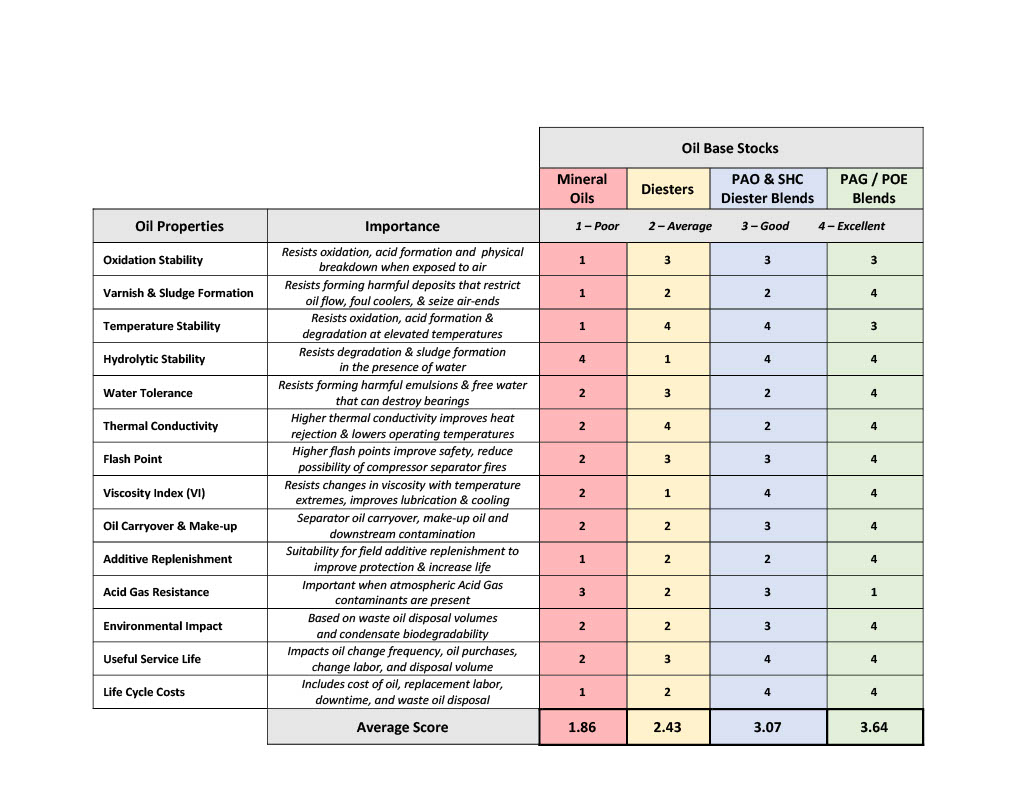
Each oil base stock has inherent physical and chemical properties, along with its own performance advantages and limitations. Knowing the specific base stocks used in your oil and their approximate proportions will help you assess the overall performance and suitability of your oil blend for your compressor’s unique operating conditions.
Base Stocks
- Mineral Oils: Mineral oils are the most affordable hydrocarbon oils, produced from the ground and refined to remove impurities. Commonly used in motor vehicles, these oils offer relatively poor service life in rotary screw air compressors (less than 2,000 hours). They are prone to forming varnish, have poor solvency, limited water tolerance, and average thermal conductivity, flash point, and viscosity index. Once used primarily as “factory fill” oils in early rotary screw compressors, mineral oils are now considered “throw-away” oils, reserved for portable air compressors or heavily contaminated environments requiring frequent oil changes.
- Diester Oils: Diesters are synthetic oils initially developed for reciprocating air compressors to prevent carbon build-up at high temperatures. Diesters have excellent solvency, making them effective for short-term varnish cleaning. However, they can be incompatible with many compressor elastomers and may cause swelling, softening, and leaks over time. Diesters also have poor water tolerance and hydrolytic stability and tend to cause sludge formation when exposed to water. Due to more negative properties than positive, diesters are generally used as secondary base stocks and blended with other synthetics to improve solvency and additive incorporation.
- PAOs (Polyalphaolefins) and SHCs (Synthetic Hydrocarbons): PAOs and SHCs are both hydrocarbon oils that perform similarly in rotary screw compressors, though they are produced through different processes. PAOs are true synthetics, while SHCs are mineral oils that undergo extra refining to improve performance. These oils exhibit longer life than mineral oils (4,000 – 8,000 hours), but both have poor solvency, potential to form varnish, and average water tolerance and thermal conductivity. Because of their poor solvency, they are often blended with diesters and have limited effectiveness in replenishing additives in the field.
- PAGs (Polyalkylene Glycols) and POEs (Polyol Esters): PAGs and POEs are advanced synthetic oxygenated hydrocarbons that provide superior performance in most compressor environments. PAGs were initially developed for use as fire-retardant hydraulic fluids, and POEs are known for their high-temperature stability. These oils have excellent solvency, hydrolytic stability, resistance to sludge formation, and high viscosity index. PAG/POE blends are highly versatile, providing excellent performance in hot, humid environments and offering superior water tolerance. They also perform well in oil purification processes, extending oil life up to 16,000 hours in normal conditions, or up to 80,000 hours with supplemental purification.
Choosing the right oil for a rotary screw compressor depends on the unique operating conditions, such as the environment, air quality, load profile, and maintenance practices. The selection of base stocks, along with the oil’s performance properties, plays a vital role in ensuring the compressor’s efficiency and longevity. Understanding the strengths and weaknesses of different oil base stocks will guide users toward the best possible choice for their compressors, ensuring optimal performance and reducing maintenance costs.