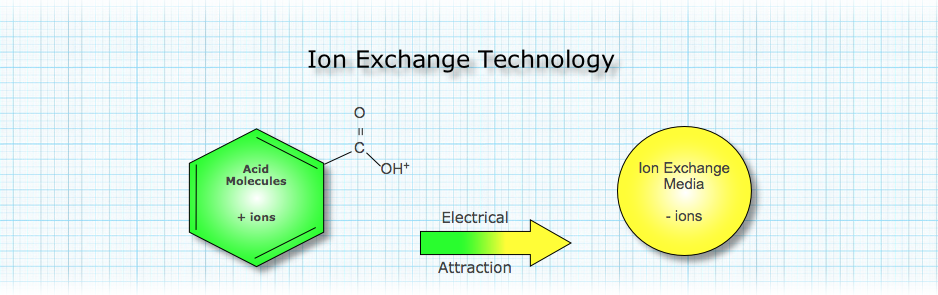
Ion exchange filter liquid separation technology has been in use for decades in a wide variety of industrial applications. These include chemical processing, waste water treatment, demineralization, heavy metal recovery, and acid removal. Ion exchange technology acts like a “chemical sponge." It is based upon the electrical attraction of oppositely charged matter (ions) to selectively attract and remove a particular contaminant or species of interest. Some of the industries that rely upon ion exchange technology to solve demanding problems include the Nuclear, Mining, Chemical Processing, Power, Pharmaceutical, Wastewater and Food processing industries.
First of all, ions are electrically charged atoms or molecules that have either a positive (cation) or negative (anion) charge. A compressor produces carboxylic acids comprised of positively charged Hydronium ions as its fluid oxidizes. Oil containing these charged acid molecules will come in contact with Fluid Metrics’ proprietary ion exchange media. Then, the acids are attracted to and adsorbed by the anionic media and are physically removed from the oil. Harmful acid molecules become permanently bonded to the disposable media which neutralizes the acid and controls the fluid’s Total Acid Number (TAN) and pH. Unlike Fullers Earth and some other acid removal media, the Fluid Metrics media acts as a one-way acid adsorber where nothing is released back into the oil that could change or otherwise harm the oil.
Graph on Ion Exchange Technology
Fluid Metrics’ COP ion exchange fluid was originally developed, tested and proven by The Dow Chemical Company. They are the makers of Ingersoll Rand’s Ultracoolant™ and Sullair’s Sullube™. Dow Chemical is the world’s largest manufacturer of synthetic compressor fluids. Additionally, it is also a world leader in ion exchange liquid separation technologies.
We relied on their in-depth knowledge of the chemistries of both technologies. They conducted nearly three years of extensive testing to determine the effectiveness of our ion exchange at removing acids from a variety of industrial lubricants.
Included in their testing were today’s most common base stocks of:
- Polyglycol.
- PAO.
- Ester blended synthetic fluids.
- Mineral based oils.
As a result, Dow’s testing proved this technology to be “extremely effective at removing acids and controlling TAN and pH in these lubricants”. Dow further determined that this technology, “did not contaminate or otherwise harm the treated lubricants in any way. Based on our testing and unique knowledge of both ion exchange resins and synthetic compressor lubricants, Dow fully endorses this technology for use in the purification of the above mentioned rotary screw compressor lubricants.”
Get Our Ion Exchange Technology
Finally, contact us to learn more about how our products can help prolong the efficiency and operating life of your equipment.
FREE E-Book Download:
How to improve reliability and reduce maintenance costs in rotary screw air compressors